Some books entertain you. Some impress you. And a rare few quietly stay in your head long after you finish them—reshaping how you look at the world around you.
Aldous Huxley’s Brave New World (1932) belongs firmly in that last category.
Often mentioned alongside George Orwell’s 1984, this novel doesn’t predict a world ruled by fear or violence. Instead, it imagines something far more uncomfortable: a society where people are controlled not because they are forced to obey, but because they are too satisfied to question anything.
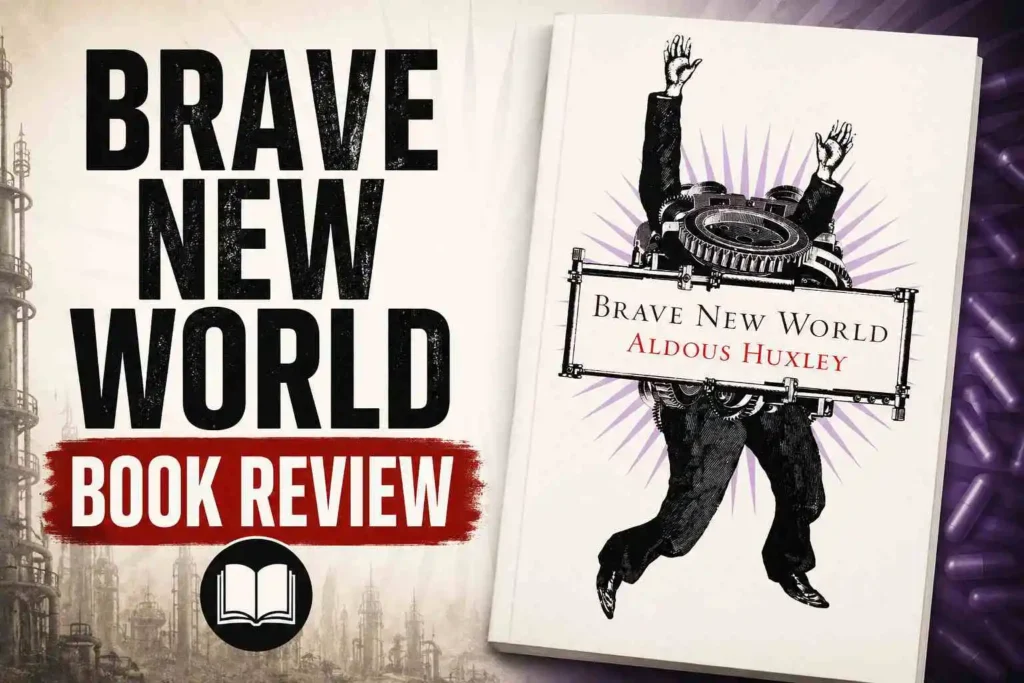
That’s what makes this book so debated even today. It’s not just a dystopian story—it’s a challenge to how we define happiness, freedom, and progress.
So, is Brave New World worth reading in 2026? Let’s break it down honestly.
Quick Verdict: Is Brave New World Worth Reading?
Overall Rating: 4.5/5 Stars on Amazon
This is not a “page-turner” in the traditional sense. You won’t find constant action or emotional storytelling designed to hook you every single chapter. Instead, this is a thinking novel—one that slowly builds an unsettling picture of the future and then leaves you sitting with deeply uncomfortable questions.
The Breakdown
| What Works | What Doesn’t Work |
| Brilliant & Original Vision: A masterclass in dystopian world-building and social structure. | Slow Middle Pacing: The narrative momentum noticeably drags during parts of the second half. |
| Disturbingly Modern: Tremendously relevant to our current era of social media, digital life, and consumption. | Distant Characters: The cast can feel emotionally detached, acting more as mouthpieces for philosophy than real people. |
| Powerful Core Themes: Deeply explores the trade-off between forced surface-level happiness and true freedom. | Concept-Heavy: The book prioritizes testing massive ideas over fluid, character-driven storytelling. |
What Is Brave New World About?
At first glance, the World State appears to be a perfect society.
There is no poverty. No war. No unemployment. People are stable, entertained, and generally happy. Everything is efficient and controlled.
But this “perfect world” has a hidden foundation.
Humans are no longer born naturally. They are engineered in laboratories and assigned roles before they even exist. Society is divided into castes—Alphas at the top, Epsilons at the bottom—each conditioned to accept their place without resistance.
From childhood, citizens are trained to enjoy what they are supposed to enjoy, think what they are supposed to think, and avoid anything that might create discomfort.
And when discomfort does appear, it is quickly erased using a drug called Soma—a substance that removes pain, doubt, and emotional struggle instantly.
Into this world arrives John the Savage, a man raised outside this system, who begins to question whether this version of happiness is worth the cost of being human.
How Readers Rate Brave New World in 2026
Amazon Ratings and Popular Reception
Across major platforms, the book consistently holds an impressive 4.5 out of 5 stars average from tens of thousands of global readers. What stands out in these reviews is not just appreciation, but genuine surprise. Many readers log on expecting an outdated literary relic, but instead discover a text that feels disturbingly modern.
According to the collective customer feedback on the Amazon Brave New World Hub, common reactions frequently include variations of:
- “Feels like it was written about today”
- “More relevant now than ever before”
- “A scarily accurate prediction of modern social media and consumerism”
For the average casual reader, the book reads less like an old piece of fiction and more like an active observation of our current digital landscape.
Goodreads Ratings and Literary Criticism
When you pivot to dedicated book communities, the response becomes much more layered. On the Goodreads Brave New World Community Page, where the book holds a weighted 3.98 out of 5 stars across over two million ratings, readers are more divided in their reasoning.
A clear consensus emerges from the literary crowd: the ideas are exceptional, but the storytelling is not for everyone.
Reviewers frequently praise Huxley’s predictive intelligence while pointing out that the novel heavily prioritizes philosophical concepts over deep emotional character arcs. Ultimately, managing your expectations matters most with this classic. If you dive in expecting a fast-paced, gripping narrative thriller, you may struggle with the pacing; however, if you enjoy dense philosophical fiction, it is incredibly rewarding.
Why Reviews Are So Divided
The split in opinion usually comes down to two different ways of judging the book:
- Some readers evaluate it as a story
- Others evaluate it as an idea
Those who judge it as a story often find it slow and emotionally distant.
Those who judge it as an idea often consider it one of the greatest dystopian novels ever written.
Both perspectives are valid—which is exactly why the debate continues decades later.
Why Readers Still Can’t Agree on Brave New World
“Too Real to Ignore”
One of the strongest reactions readers have is how modern the book feels.
Many draw parallels between Huxley’s Soma and today’s world of:
- social media scrolling
- streaming platforms
- endless entertainment loops
- instant gratification culture
Whether or not these comparisons are perfect, the emotional response is consistent: the book feels familiar in an uncomfortable way.
Brilliant Ideas, Uneven Storytelling
Most readers agree on one thing: Huxley’s ideas are extraordinary.
But the storytelling experience is more polarizing.
The early sections—where the World State is introduced—are often praised as fascinating and immersive. However, some readers feel the middle of the novel slows down as it shifts into philosophical exploration.
This is not a flaw for everyone, but it does affect readability depending on what you expect from fiction.
The Lack of a Traditional Hero
Unlike most modern novels, Brave New World doesn’t give you a clear hero to root for.
Characters like Bernard Marx, Lenina Crowne, and John the Savage each represent different tensions within the system—but none are classic “heroes” in the usual sense.
Even Mustapha Mond, who represents authority, is not portrayed as a simple villain.
This creates a reading experience that feels more like observing a debate than following a story.
A Book That Starts Arguments, Not Ends Them
The novel doesn’t try to give answers.
Instead, it leaves readers with questions that linger long after the final page:
- Is happiness valuable if it removes freedom?
- Is suffering necessary for meaning?
- Can a perfect society still be human?
That open-endedness is a major reason people still discuss it today.
Why Brave New World Feels More Relevant Today Than Ever
One reason this book remains so widely read is its unusual type of prediction.
Huxley didn’t imagine control through fear or violence. He imagined control through comfort.
In today’s world of algorithms, personalized content, and endless digital entertainment, many readers see reflections of that idea everywhere.
The concern is not that people are forced into obedience—but that they drift into it willingly through distraction and convenience.
That’s what makes the novel feel less like history and more like a warning that keeps updating itself.
Final Thoughts (Part 1)
Brave New World is not a comfortable read, and it’s not meant to be.
It doesn’t try to emotionally grip you like modern fiction, nor does it offer simple answers. Instead, it slowly builds a world that looks appealing on the surface—and then quietly makes you question whether that appeal is actually dangerous.
In the next section, we’ll go deeper into:
- why this book is still debated alongside 1984
- the famous John vs Mustapha Mond conflict
- its strengths and weaknesses in detail
- and ultimately, whether you should actually read it or skip it
But even at this stage, one thing is already clear:
This is not just a book you read.
It’s a book you think about differently every time you look at the modern world.
Related Reviews
Looking for more entertainment coverage? Explore these reviews from OKReviewer:
- Why Is Cocktail 2 Rated “A” – Story breakdown, performances, ending explained, and our verdict.
- Made in India: A Titan Story Review – Complete box office analysis, audience response, and verdict.