
Anurag Kashyap’s Bandar is not the kind of film you watch simply to pass two hours. It is uncomfortable, dark and deliberately difficult to process. Starring Bobby Deol as Samar Mehra, the film takes a serious accusation and places its protagonist inside a legal and social system where public opinion can become a punishment of its own.
Released in theatres on June 5, 2026, Bandar is now available to stream on ZEE5 from August 28.
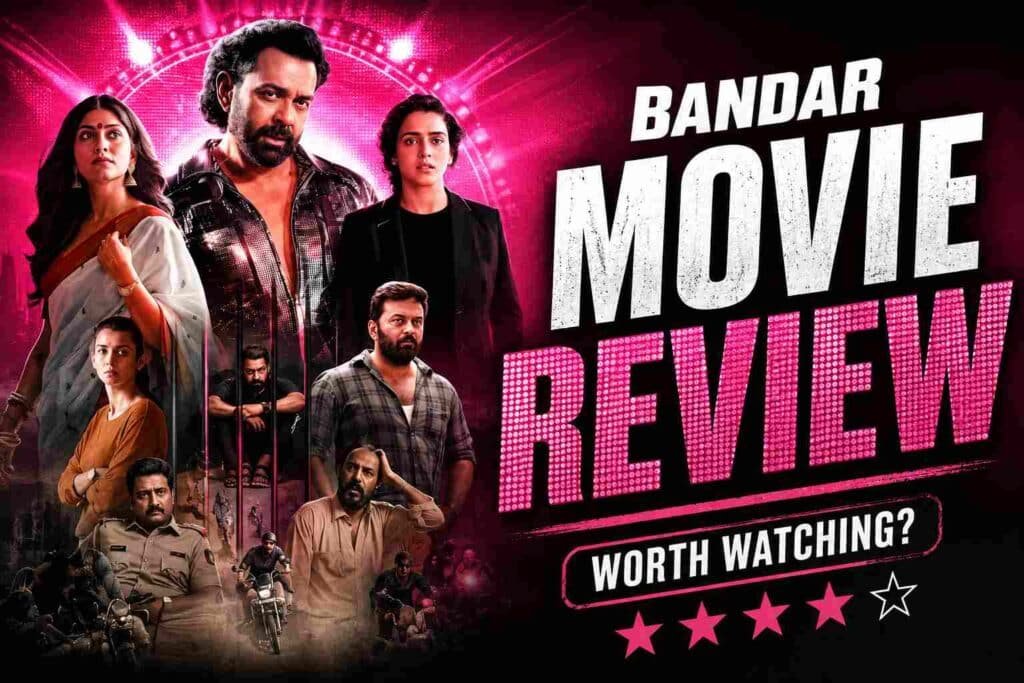
The film revolves around questions of accusation, consent, accountability, public judgement and the treatment of an accused person before the truth has been established. But this is not a courtroom thriller where every question neatly gets an answer. Instead, Bandar spends much of its runtime showing what happens to a person once the system begins moving against him.
And that is where the film becomes both compelling and frustrating.
Bandar Movie: Quick Details
| Detail | Information |
|---|---|
| Movie | Bandar |
| Director | Anurag Kashyap |
| Lead Cast | Bobby Deol, Sanya Malhotra, Sapna Pabbi, Saba Azad |
| Genre | Crime, Thriller, Drama |
| Language | Hindi |
| Theatrical Release | June 5, 2026 |
| OTT Release | August 28, 2026 |
| OTT Platform | ZEE5 |
| Runtime | Around 2 hours 15 minutes |
| Certificate | A |
The film is directed by Anurag Kashyap and features Bobby Deol, Sanya Malhotra, Sapna Pabbi and Saba Azad in important roles. ZEE5 lists the film as a Hindi crime thriller with a runtime of approximately 2 hours and 15 minutes.
Bandar Movie Story
At the centre of Bandar is Samar Mehra, an ageing television actor whose professional life is no longer what it once was.
The fame has faded. The big opportunities have disappeared. He is reduced to smaller performances and is trying to hold on to whatever remains of his old identity.
His personal life is equally complicated.
Samar becomes involved with Gayatri, a woman he meets through a dating app. Their relationship eventually turns bitter, and Samar cuts contact with her. What follows changes his life completely when Gayatri accuses him of rape.
Samar denies the allegation and insists that he has been wrongly accused. But once the accusation reaches the authorities, his version of events is no longer enough to protect him.
He is arrested and enters a legal system that becomes increasingly difficult to navigate.
From this point, Bandar shifts from a relationship drama into a much darker prison and survival story. Samar has to deal with delayed legal proceedings, the hostility of prison life and the humiliation that comes with being treated as guilty before the case has reached its conclusion.
The film’s central question is therefore bigger than simply asking whether Samar is innocent or guilty.
What happens to a person when society has already decided who they are?
That question gives Bandar its strongest dramatic foundation.
Bandar Movie Review
Story and Screenplay
The premise of Bandar is provocative, and that is both its biggest strength and its biggest challenge.
The film enters a sensitive conversation around false accusations and the experiences of men who claim to have been wrongly accused. At the same time, it touches on consent, relationships, emotional manipulation, accountability and the way society reacts to allegations.
The first half is particularly effective because the story keeps you interested in Samar’s situation. You want to understand what happened between him and Gayatri. You also want to know what will happen once the allegation changes the course of his life.
The prison portions add another layer to the story. Instead of treating imprisonment as simply a backdrop, the film uses it to show Samar’s gradual loss of dignity and control.
However, the screenplay becomes less focused as it moves forward.
Several ideas are introduced, but not all receive the same level of attention. Critics have also pointed out that the second half becomes repetitive and loses some of the momentum established earlier.
This is where Bandar could have been sharper.
The film has enough material for a powerful examination of relationships, justice, public judgement and accountability. At times, however, it appears more interested in making the audience experience Samar’s suffering than in fully exploring every side of the questions it raises.
Direction
Anurag Kashyap does not make Bandar comfortable viewing.
The prison is dirty, claustrophobic and hostile. There is little attempt to make Samar’s experience visually appealing. Instead, the atmosphere constantly reinforces the feeling that he is trapped.
That approach works.
Kashyap’s direction is strongest when the film allows silence, uncomfortable conversations and small moments of humiliation to carry the emotional weight. The prison environment gradually becomes a character in itself.
There is also a distinct lack of a conventional Bollywood treatment. The film does not rush towards a dramatic courtroom confrontation or provide easy emotional victories.
But the same commitment to discomfort sometimes works against the film.
The narrative becomes repetitive, particularly in the latter portions, and the film’s insistence on staying with Samar’s suffering can make the larger argument feel narrower than it initially appears. India Today’s review similarly noted that the film begins with moral complexity but gradually moves towards a more one-sided perspective.
Bobby Deol’s Performance
Bobby Deol is the biggest reason to watch Bandar.
As Samar, he has to play a man who is slowly losing almost everything: his reputation, freedom, confidence and eventually his sense of identity.
There are no larger-than-life action scenes to hide behind. Instead, Deol has to communicate fear, frustration, helplessness and humiliation through small changes in expression and body language.
And he does that remarkably well.
Some of the film’s most powerful moments arrive when Samar finally breaks down emotionally. The performance feels restrained for much of the film, which makes those moments of emotional collapse hit harder.
Several critics have singled out Deol’s performance as one of the film’s major strengths, with reviews describing it as one of his finest or most affecting performances.
For an actor who has recently been seen in physically imposing or intimidating roles, Bandar offers a very different side of Bobby Deol.
Here, vulnerability is the performance.
Sanya Malhotra, Sapna Pabbi and Saba Azad
Sanya Malhotra plays Suhaani, Samar’s sister, who becomes an important part of his support system outside prison.
Her character brings an emotional perspective to the story because she is not simply watching Samar’s situation from a distance. She is also forced to deal with the social and legal consequences surrounding him.
Sapna Pabbi plays Gayatri, the woman whose accusation sets the story in motion. Her role is crucial because the entire narrative depends on the complicated history between her and Samar.
Saba Azad plays Khushi, Samar’s current partner.
The supporting performances generally fit the grounded tone of the film, although some characters could have benefited from greater development. The cast also includes Indrajith Sukumaran, Jitendra Joshi, Raj B. Shetty and Riddhi Sen.
Music, Cinematography and Technical Aspects
Bandar does not depend heavily on songs or glossy visuals.
The technical treatment is built around the mood of the story. The prison interiors, cramped spaces and muted environment contribute to the film’s sense of discomfort.
The cinematography by Saiyed Shaaz Rizvi keeps the visual language grounded, while the music by Shivahari Varma supports the film rather than overpowering it.
This is important because Bandar is ultimately about atmosphere.
You are supposed to feel trapped with Samar.
The technical choices help create that feeling.
Also Read: Toxic Movie Review: Yash’s Gangster Epic Is Stylish, Ambitious and Disturbing
What Works in Bandar?
1. Bobby Deol’s performance
Deol carries the emotional weight of the film and gives Samar enough vulnerability to make his downfall matter.
2. The uncomfortable subject
Whether you agree with the film’s perspective or not, Bandar attempts to start a difficult conversation.
It raises questions about what happens when an accusation becomes a social verdict.
3. The prison setting
The prison portions are among the film’s most effective sections. They communicate how quickly an accused person’s identity can disappear behind a label.
4. The first half
The opening portions create curiosity and maintain tension effectively. You want to understand Samar’s relationship with Gayatri and how the situation reached the point it does.
5. It refuses easy entertainment
Bandar is not designed as a conventional thriller with constant twists.
It wants the audience to sit with uncomfortable questions, and that makes it more interesting than a straightforward crime drama.
What Doesn’t Work in Bandar?
1. The second half loses momentum
The biggest problem is pacing.
The film establishes a strong conflict but spends too much time circling around similar ideas later. Multiple reviews have noted the repetitive or uneven nature of the second half.
2. Some characters feel underdeveloped
The story introduces several people who could add important perspectives, but not all of them receive enough space.
This becomes noticeable because the film is dealing with a subject that requires more than one point of view.
3. The moral complexity narrows
This may be the film’s most debatable issue.
Bandar starts with an opportunity to explore a complicated situation where questions of consent, responsibility, accusation and public judgement can exist simultaneously.
But as the story progresses, the focus increasingly shifts towards Samar’s suffering.
That makes the film emotionally effective, but arguably less balanced in its examination of the larger issue. India Today specifically noted this shift in its review.
4. It can feel repetitive
The film repeatedly returns to Samar’s humiliation and helplessness.
Some of those moments are powerful. Others feel like the film is making the same point again.
Bandar Movie Ending Explained
Spoilers ahead.
The ending of Bandar is deliberately open rather than providing the kind of definitive resolution audiences might expect from a conventional courtroom thriller.
Instead of reducing everything to a simple answer, the film leaves Samar’s situation carrying a degree of uncertainty.
This is important because the film is ultimately less interested in delivering a neat legal conclusion than in showing what the experience has done to Samar.
By the end, the question is no longer simply whether Samar can prove his version of events.
It is about what remains of him after everything he has gone through.
The title Bandar also gains greater meaning in this context. The film repeatedly plays with the idea of a person becoming an object inside a larger system, almost like a performer trapped inside someone else’s circus.
That interpretation fits the film’s larger theme: a person can lose control over his own identity when institutions, media and public opinion begin defining him.
The ending therefore feels less like a solution and more like a final question left with the audience.
Bandar Movie Rating
Rating: 3.5/5
Bandar gets 3.5 out of 5 for its strong central performance, disturbing atmosphere and willingness to tackle an uncomfortable subject.
The film loses points for its uneven second half, repetitive stretches and the narrowing of its broader moral questions.
It is not a perfect film, but it is certainly a film that gives you something to discuss after the credits.
Is Bandar Worth Watching?
If you enjoy dark crime dramas, psychological thrillers and socially uncomfortable films, Bandar is worth watching.
It is especially worth considering if you enjoy Anurag Kashyap’s style of storytelling or want to see Bobby Deol in a dramatically different role.
However, this is not the right pick if you are looking for a fast-paced thriller with constant twists and a satisfying, clearly explained ending.
The film demands patience.
It also deals with sexual assault allegations, prison violence and emotional distress, so viewers should be prepared for some disturbing material.
The good news for viewers who missed its theatrical run is that Bandar is now available on ZEE5 from August 28, 2026.
Final Verdict
Bandar is an uncomfortable film about an uncomfortable subject.
Its biggest strength is Bobby Deol, who gives Samar Mehra a deeply vulnerable performance and makes his emotional collapse believable. Anurag Kashyap’s direction also succeeds in creating a grim, claustrophobic world where the consequences of an accusation extend far beyond the courtroom.
But the film is not without problems.
Its second half loses some of the grip of the first, several subplots remain underexplored, and its treatment of a complicated issue can feel increasingly one-sided.
Still, Bandar is difficult to dismiss.
It asks questions that are uncomfortable precisely because there are no easy answers. And while the film may not explore every side of those questions equally well, it leaves enough behind to keep the conversation going after it ends.
Verdict: Worth watching if you prefer thought-provoking crime dramas over conventional thrillers.
Pingback: Hanuman Ansh on OTT - OKReviewer