
Post-apocalyptic stories usually come with a very specific mood. Grey skies. Broken cities. Silence that feels heavy. Whether it’s The Walking Dead or The Last of Us, we’ve been trained to expect one thing from the end of the world — pure, unfiltered despair.
And then came Sweet Tooth on Netflix.
At first glance, it feels almost like it doesn’t belong in the same genre. A story about a deadly pandemic, hybrid children born between humans and animals, and a collapsing civilization… yet somehow it leaves you with warmth instead of dread.
Based on Jeff Lemire’s beloved DC/Vertigo comic series, the show follows Gus (Christian Convery), a gentle, deer-antlered boy raised in isolation who steps into a dangerous world in search of his mother. Along the way, he meets Tommy Jepperd (Nonso Anozie), a hardened survivor with a violent past who becomes his reluctant protector.
But Sweet Tooth isn’t just a road survival story. It’s a rare example of how a dark, brutal comic can be transformed into something tender, hopeful, and deeply human — without losing its emotional weight.
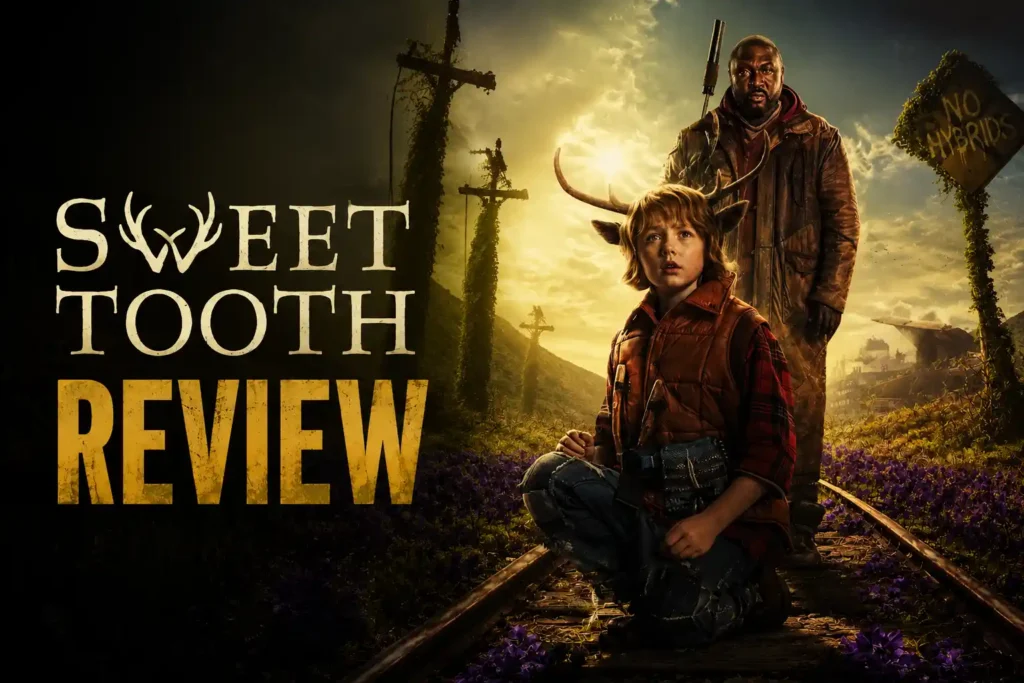
Let’s talk about how this adaptation pulled off that almost impossible shift.
Page to Screen: The Radical Tonal Shift
To understand just how bold Netflix’s version is, you have to look at the source material.
Jeff Lemire’s original comic is raw, bleak, and often uncomfortable. The world is violent, the tone is grim, and innocence is something the story barely allows to survive. It’s powerful — but it’s heavy in a way that never lets go.
Now enter Netflix’s adaptation.
Instead of recreating that darkness frame by frame, showrunner Jim Mickle makes a surprising choice: he softens the surface brutality and amplifies the emotional core. What could have been a horror-heavy apocalypse becomes something closer to a dark fairy tale.
And it works.
The world of Sweet Tooth doesn’t feel like it’s dying — it feels like it’s being reclaimed. Nature doesn’t just survive the apocalypse; it thrives in it. Forests swallow highways, cities become gardens, and silence feels peaceful rather than dead.
Even better, the series expands its world beyond the comics. Characters who once existed on the margins are given full emotional lives. The Animal Army, for example, becomes more than just a chaotic group — it feels like a generation of abandoned kids trying to build meaning in a broken world.
And Dr. Aditya Singh? Easily one of the biggest upgrades.
In the comics, he’s closer to a functional archetype. In the series, he becomes something far more painful — a man slowly unraveling under love, guilt, and desperation, making choices that feel horrifying precisely because they feel understandable.
The Heart and the Monsters: Character Dynamics
If Sweet Tooth works at all, it’s because its characters don’t just exist in the story — they carry it.
The Perfect Dynamic: Gus and Big Man
At the center of everything is Gus and Jepperd — and their relationship is the emotional heartbeat of the series.
Gus isn’t just innocent; he feels almost untouched by the cruelty of the world. Christian Convery plays him with a kind of natural wonder that never feels forced or overly sweet.
Opposite him, Nonso Anozie’s Jepperd is the definition of emotional contradiction — a man built like a weapon but slowly softened by a child who refuses to see the world as broken.
What makes their journey so compelling is how unforced it feels. They don’t become family because the plot demands it. They become one because survival slowly turns into trust… and trust turns into something deeper.
The Moral Gray Zone: Dr. Aditya Singh
Adeel Akhtar delivers one of the most quietly devastating performances in the series.
Dr. Singh isn’t a villain you hate. He’s a man you understand a little too easily.
Every decision he makes is rooted in love — specifically, the love for his infected wife. And that’s what makes his descent so uncomfortable to watch. There are no easy answers here, just increasingly impossible choices.
The show doesn’t excuse him. But it refuses to simplify him too.
And that’s what makes his arc linger long after the episode ends.
The Contrast: General Abbot
Then there’s General Abbot — loud, theatrical, and unsettling in a very different way.
Neil Sandilands plays him like a man who believes he’s already history’s main character. Every speech feels like a performance, every action like a declaration.
But underneath all the flair is something much darker: pure resistance to change. Abbot isn’t just fighting hybrids — he’s fighting the idea that the world has moved on without him.
That’s what makes him dangerous.
Not just his power… but his refusal to let go.
If you’re exploring the latest entertainment releases, don’t miss our Raakh Review & OTT Verdict: Hit or Flop, where we break down the story, performances, direction, and our final verdict.
Crafting a Nature-Reclaimed World: Visuals & Production
One of the first things you notice about Sweet Tooth is that it doesn’t look like other apocalypse shows.
Instead of dust and decay, you get life.
Filmed across New Zealand’s breathtaking landscapes, the series feels almost like a fantasy adventure that accidentally wandered into a dystopian world. Mountains stretch endlessly, forests feel alive, and abandoned cities are slowly being swallowed by green.
The apocalypse here doesn’t feel like an ending. It feels like nature hitting reset.
And then there are the hybrids.
What makes them so effective is how real they feel. The show avoids overusing CGI and instead relies on practical effects and clever puppetry. That choice pays off in a huge way.
Gus’s deer ears, for example, aren’t just digital add-ons — they react in real time, synced with his emotions. When he’s scared, they flatten. When he’s curious, they perk up.
It’s a small detail, but it changes everything. Suddenly, the hybrids don’t feel like effects — they feel alive.
Timely Themes and Lasting Solutions
Watching Sweet Tooth during the pandemic era hits differently.
A story about a global virus spreading through humanity while society collapses could have easily leaned into pure darkness. And yet, this show constantly pushes in the opposite direction.
Yes, it shows fear. Yes, it shows how quickly people turn on each other. But it refuses to stay in that space.
Instead, it keeps circling back to one idea: connection.
Not survival. Not dominance. Connection.
The show argues — quietly but firmly — that identity isn’t about what you’re born as. It’s about who stands beside you when everything falls apart.
And in a world that keeps breaking itself apart, that message lands harder than any action sequence ever could.
The Verdict: A Rare Triumph in Adaptation
Most adaptations either stay too faithful or drift too far away.
Sweet Tooth does something rarer — it understands what the story feels like, not just what it is.
Over its run, the series reshapes a dark, violent comic into something softer, but not weaker. It trades shock for emotion, brutality for warmth, and somehow ends up feeling even more powerful because of it.
It proves that a good adaptation doesn’t need to copy everything. It just needs to understand the soul of the story — and build something honest from there.
And that’s exactly what Sweet Tooth does.
In a genre obsessed with endings, it quietly chooses beginnings instead.
Related Reviews
Looking for more entertainment coverage? Explore these reviews from OKReviewer:
- Bharat Bhhagya Viddhaata Hit or Flop – Story breakdown, performances, ending explained, and our verdict.
- Disclosure Day Post Credit Scene Explained – Complete box office analysis, audience response, and verdict.