
What happens when a police officer who has spent most of her life trying not to upset anyone finally decides to ask questions?
That is the real story at the heart of Babita Singh Reporting.
The film, directed by Ambiecka Pandit and written by Amita Vyas, follows Babita “Baby” Singh, a junior police officer whose trip to her hometown takes an unexpected turn after her childhood friend is found dead. What begins as a personal tragedy gradually turns into an unofficial investigation, forcing Babita to confront not only a murder mystery but also the people and circumstances that have kept her from speaking up.
Starring Nimisha Sajayan in the lead, alongside Barun Sobti, Anshuman Pushkar, Rajesh Kumar, Sunita Rajwar and others, Babita Singh Reporting is now streaming on Amazon Prime Video.
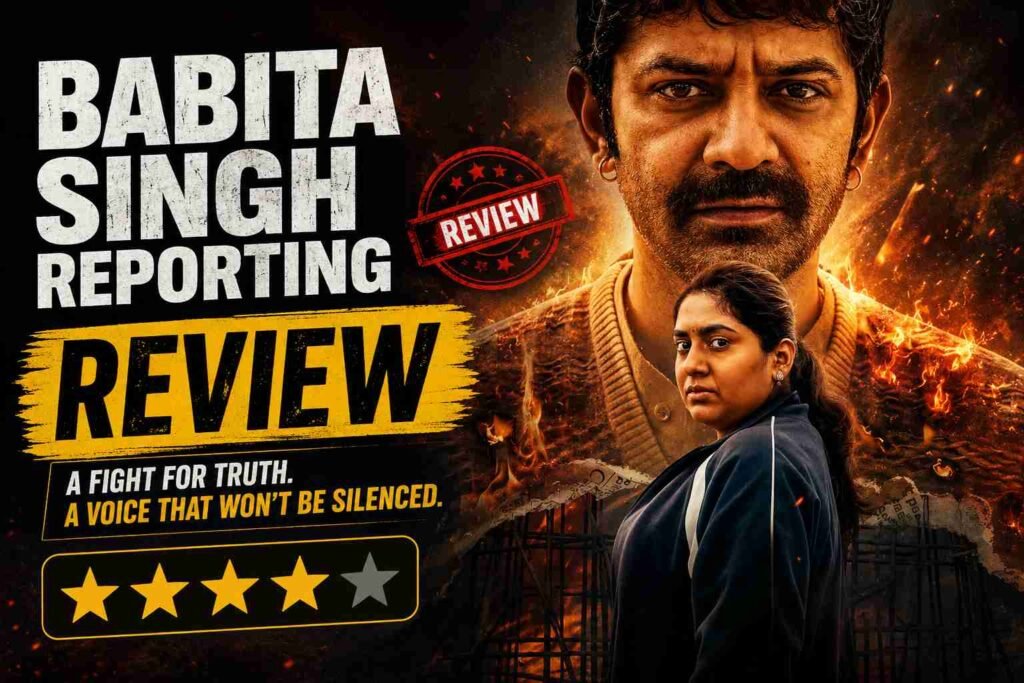
The film may look like another small-town murder mystery at first. But its real investigation is much more personal.
It asks a simple question: Can Babita find the courage to stop living for everyone else’s approval?
Babita Singh Reporting: Quick Details
| Detail | Information |
|---|---|
| Movie | Babita Singh Reporting |
| Director | Ambiecka Pandit |
| Writer | Amita Vyas |
| Lead Cast | Nimisha Sajayan, Barun Sobti, Anshuman Pushkar |
| Supporting Cast | Rajesh Kumar, Sunita Rajwar, Geetika Vidya Ohlyan |
| Genre | Crime, Mystery, Drama |
| Language | Hindi |
| Release Date | August 28, 2026 |
| OTT Platform | Amazon Prime Video |
| Runtime | Around 2.5 hours |
The film began streaming on Prime Video on August 28, 2026. It is directed by Ambiecka Pandit, with Nimisha Sajayan playing the central character and Barun Sobti appearing as Babita’s childhood friend Bansi.
Babita Singh Reporting Story
Babita Singh, or Baby as almost everyone calls her, is an Assistant Sub-Inspector working in Delhi.
She isn’t the stereotypical police officer we usually see in crime thrillers.
There is no swagger, no dramatic introduction and no constant display of authority.
Babita is quiet, hesitant and constantly worried about keeping other people happy.
She joined the police force after her father, who was also in the force, died in action. Because she received the job on compassionate grounds, Babita carries a strange sense that she hasn’t completely earned her position.
Even at work, she struggles to say no.
When she wants leave to attend her sister-in-law’s godh bharai ceremony in Rewa, she finds herself accepting a suspension-related arrangement simply because it is easier than standing up for what she wants.
That detail tells you almost everything about Babita.
She can handle a police job.
She just doesn’t know how to handle herself.
Things change when she reaches Rewa and reconnects with Bansi, her childhood friend. Bansi is an artist and someone who represents a part of Babita’s life that she has left behind.
But their reunion doesn’t last long.
Bansi is found murdered.
The local police don’t appear particularly interested in digging deeper, and Babita soon becomes convinced that there is more to his death than what she has been told.
So she starts investigating on her own.
What follows is a slow-burning murder mystery involving family secrets, old relationships, small-town politics and uncomfortable truths.
But the deeper Babita goes into the case, the more she begins investigating something else too.
Her own life.
Know more about: Toxic Movie Review: Yash’s Gangster Epic Is Stylish, Ambitious and Disturbing
Babita Singh Reporting Review
Story and Screenplay
The biggest strength of Babita Singh Reporting is that it doesn’t treat its murder mystery as the only story.
Yes, there is a dead body.
Yes, there are suspects.
Yes, Babita needs to figure out what happened.
But the film is equally interested in why Babita has become the person she is.
That makes the screenplay more character-driven than a conventional whodunnit.
Instead of introducing Babita as a fearless cop who suddenly becomes brilliant at solving crimes, the film lets her transformation happen gradually.
At the beginning, she is the person who agrees to things because saying no feels harder.
At home, she has to deal with family expectations and casual comments about her appearance. At work, she doesn’t seem particularly confident in her own abilities. Her husband Sharad and her in-laws add another layer to the pressure she is already carrying.
The murder investigation slowly changes that.
For once, Babita has something she refuses to let go.
That emotional progression gives the story its strongest moments.
The weakness is that the actual mystery isn’t always as strong as the character study surrounding it.
Once the investigation reaches its later stages, some developments feel less convincing than the carefully built early portions. Several reviews have pointed out that the final act loses some of the grounded quality established earlier.
So, if you’re watching purely for a tightly constructed murder mystery, you may find the payoff underwhelming.
If you’re watching to understand Babita, however, the film has considerably more to offer.
Direction
Ambiecka Pandit takes a restrained approach to the material.
There is no need to turn every discovery into a dramatic revelation.
Instead, the film spends time observing Babita’s surroundings: her family, her workplace, her hometown and the everyday interactions that slowly reveal why she has become so hesitant.
That approach works particularly well in the smaller moments.
A comment about her weight.
A family member dismissing her opinion.
Someone assuming she will simply agree.
None of these moments is necessarily shocking on its own.
But together, they create a portrait of a woman who has spent years being told, directly and indirectly, that keeping everyone else comfortable is more important than expressing herself.
That is where the direction finds its strongest voice.
The film doesn’t need Babita to deliver a speech about patriarchy.
It shows her living inside it.
Several critics have highlighted this grounded treatment of women’s everyday experiences as one of the film’s major strengths.
Nimisha Sajayan’s Performance
Nimisha Sajayan is the heart of Babita Singh Reporting.
Her performance works because she doesn’t try to make Babita instantly impressive.
Instead, she plays her as awkward, uncertain and sometimes frustratingly passive.
And that is exactly what the character requires.
You can see Babita thinking before she speaks.
You can see her wanting to disagree and then deciding not to.
You can see how uncomfortable she is when people focus on her appearance.
Most importantly, you can see the gradual change.
The Babita who begins the film is not the same woman we see later.
The transformation doesn’t happen through one heroic moment. It happens through dozens of small decisions.
Nimisha makes those changes believable.
Her performance has also received praise from multiple reviews, with critics particularly noting how naturally she inhabits the character and the film’s grounded setting.
Barun Sobti as Bansi
Barun Sobti has a comparatively limited role, but Bansi’s presence matters because he is connected to Babita’s past.
Their relationship gives the story an emotional layer that goes beyond the murder investigation.
Bansi isn’t simply a plot device.
For Babita, he represents familiarity, memory and a version of herself that existed before she became trapped in the expectations of adulthood.
Sobti makes the most of his screen time, although one criticism of the film is that his character could have been given more room to develop.
Anshuman Pushkar and the Supporting Cast
Anshuman Pushkar plays Sharad, Babita’s husband.
His character isn’t written as a straightforward villain, which makes the relationship more interesting. The tension comes from the everyday dynamic between the two rather than from exaggerated confrontations.
Sunita Rajwar is particularly effective as Babita’s mother-in-law.
Her character embodies the kind of casual, everyday pressure that the film repeatedly examines. The comments and expectations may seem ordinary, but they gradually reveal how deeply those attitudes affect Babita.
Rajesh Kumar also delivers a dependable performance as SI Sethi, while Geetika Vidya Ohlyan makes an impression in her appearance as Babita’s colleague.
Journalism and Realism: What Is the Film Really About?
Despite the word “Reporting” in its title, Babita Singh Reporting isn’t a journalism story.
Babita is a police officer, and the “reporting” is essentially connected to her investigation into Bansi’s death.
What makes the film interesting is the way it treats investigation as a process of observation.
Babita begins noticing things that others have ignored.
People who don’t seem suspicious at first begin behaving differently.
Family relationships start looking less innocent.
Old connections acquire new meanings.
And Babita herself starts trusting her instincts.
This is where the film feels closest to a traditional crime procedural.
But instead of making the investigation the entire point, the screenplay uses it as the mechanism through which Babita finds her own voice.
The murder gives her a reason to stop pleasing everyone.
That is arguably the film’s most interesting idea.
Cinematography, Editing and Background Score
The visual treatment matches the film’s grounded tone.
There is no glossy version of small-town India here. Rewa feels lived-in, and the family spaces often feel just as claustrophobic as the investigation itself.
The camera observes rather than constantly announcing what the audience should feel.
The editing is generally patient, allowing the characters and relationships to develop.
However, that patience becomes a problem in places.
At roughly two-and-a-half hours, the film could have benefited from a tighter edit. Hindustan Times specifically noted that around 15 minutes could have been trimmed, with certain stretches becoming repetitive.
The background score largely supports the mystery without becoming overly dramatic.
That restraint suits the film.
What Works in Babita Singh Reporting?
1. Nimisha Sajayan
The film depends heavily on Babita, and Sajayan makes the character believable from beginning to end.
2. A different kind of female cop
Babita isn’t presented as an invincible police officer.
She is uncertain, emotional and imperfect.
That makes her transformation more relatable.
3. Strong character writing
The film understands that oppression doesn’t always arrive in dramatic forms.
Sometimes it sounds like:
“Why can’t you just adjust?”
“Don’t make an issue out of it.”
“Everyone is doing this.”
Those small comments become important because Babita has heard them her entire life.
4. Small-town atmosphere
The setting feels authentic rather than decorative.
The film allows its environment to influence the characters and the story.
5. The personal transformation
The murder is the mystery.
Babita is the real story.
That distinction makes the film more interesting than a standard police procedural.
What Doesn’t Work in Babita Singh Reporting?
1. The mystery could have been stronger
The character study is often more compelling than the actual investigation.
If you expect a highly intricate whodunnit, the film may feel familiar.
2. The final act loses some momentum
The film builds a grounded world and a believable character journey, but some of the later investigative developments feel less convincing.
This has been one of the more consistent criticisms across reviews.
3. Runtime
The movie takes its time.
Sometimes that works.
Sometimes it doesn’t.
The middle portions could have been tighter, particularly where the story revisits similar emotional beats.
4. Bansi deserved more
Considering how important his death is to the entire story, Bansi’s character could have been explored further.
His relationship with Babita is emotionally important, but the film doesn’t spend enough time developing it.
Babita Singh Reporting Ending Explained
Spoilers ahead.
The ending of Babita Singh Reporting is less interested in delivering a spectacular detective reveal than in completing Babita’s personal transformation.
As Babita continues investigating Bansi’s death, she gradually realises that the truth is buried beneath relationships, family loyalties and the silence of people who have reasons to protect themselves.
But the real resolution belongs to Babita.
At the beginning, she is constantly seeking approval.
She allows other people to make decisions for her.
She doubts her instincts.
Even when she is uncomfortable, she tends to remain quiet.
The investigation changes that.
By the end, Babita is no longer simply reacting to what other people expect from her. She has started trusting her own judgement.
That is why the ending can feel slightly less satisfying if you’re expecting a traditional crime thriller payoff.
The murder mystery doesn’t receive the kind of explosive climax that some viewers may expect. Instead, the film puts greater emphasis on what Babita has become during the investigation.
This is also why some critics have described the film as more of a character study disguised as a police procedural.
The final message is fairly clear:
Solving the case matters, but finding your own voice matters too.
Babita Singh Reporting Rating
Rating: 3.5/5
Babita Singh Reporting gets 3.5 out of 5 for its grounded storytelling, strong performances and particularly Nimisha Sajayan’s portrayal of Babita.
The film loses points for its stretched runtime and a mystery that doesn’t always match the strength of its central character.
It is more successful as a story about a woman finding her voice than as a tightly constructed murder mystery.
Is Babita Singh Reporting Worth Watching?
Yes, especially if you enjoy slow-burn crime dramas with strong character development.
This is not a film for viewers looking for nonstop twists, chase sequences and dramatic police confrontations.
Instead, it works best when you allow the story to take its time.
Watch it if you enjoy:
- Character-driven crime stories
- Female-led police procedurals
- Small-town mysteries
- Social dramas with a crime angle
- Slow-burn investigations
- Nimisha Sajayan’s performances
You may want to skip it if your idea of a good murder mystery requires constant twists and a perfectly constructed final reveal.
The film is currently streaming on Amazon Prime Video.
Final Verdict
Babita Singh Reporting starts like a murder mystery but gradually reveals itself as something more personal.
The case involving Bansi gives Babita a reason to investigate, but the real investigation is happening inside her.
She is forced to question the people around her, the expectations placed on her and, most importantly, the way she sees herself.
Nimisha Sajayan makes that transformation the film’s biggest strength. She doesn’t play Babita as a larger-than-life cop. She plays her as an ordinary woman who slowly realises that she is capable of more than she has allowed herself to believe.
The film isn’t perfect. The mystery could have been tighter, the runtime could have been shorter and the final act doesn’t entirely deliver on the promise of the setup.
But there is enough here to make Babita Singh Reporting worth your time.
Verdict: Watch it if you prefer character-driven crime dramas over conventional whodunnits.
FAQs
What is Babita Singh Reporting about?
Babita Singh Reporting follows Babita “Baby” Singh, a junior police officer who returns to her hometown and becomes involved in investigating the murder of her childhood friend Bansi. The investigation also forces her to confront the personal and social pressures that have shaped her life.
Who plays Babita Singh in Babita Singh Reporting?
Nimisha Sajayan plays Babita “Baby” Singh, the film’s central character.
Who directed Babita Singh Reporting?
The film is directed by Ambiecka Pandit and written by Amita Vyas.
Who is in the cast of Babita Singh Reporting?
The cast includes Nimisha Sajayan, Barun Sobti, Anshuman Pushkar, Rajesh Kumar, Sunita Rajwar and Geetika Vidya Ohlyan.
Is Babita Singh Reporting a true story?
The film is presented as a fictional crime mystery rather than a direct true-story adaptation. Its story focuses on Babita’s investigation into her childhood friend’s death and her personal transformation.
Where can I watch Babita Singh Reporting?
Babita Singh Reporting is streaming on Amazon Prime Video from August 28, 2026.
Is Babita Singh Reporting worth watching?
Yes, if you enjoy grounded, character-driven crime dramas. The film’s strongest element is Nimisha Sajayan’s performance and Babita’s personal journey, although the mystery and final act may feel less satisfying to viewers looking for a tightly plotted whodunnit.
Pingback: Drishyam The Conclusion Review: Ending Explained, Cast, Budget & Collection - OKReviewer