
Spoiler Alert: This review contains major spoilers for House of the Dragon Season 3 Episode 8.
After an entire season of watching the Dance of the Dragons slowly turn from a political conflict into an outright disaster, House of the Dragon Season 3 finally lets the war explode.
Episode 8, titled “The Treasons at Tumbleton,” is easily one of the most important episodes of the season. It brings together several storylines that have been building for weeks, but instead of giving us a satisfying victory for either side, the finale leaves Westeros looking even more broken than before.
And honestly, that feels very House of the Dragon.
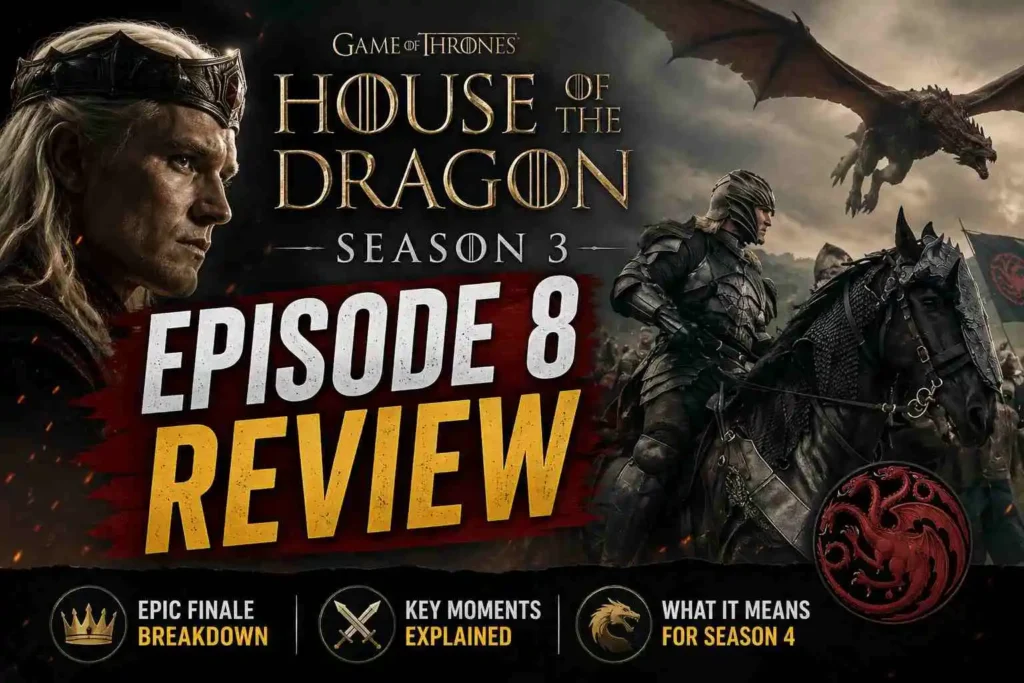
There are dragons, betrayals, executions, political desperation and one of the show’s most heartbreaking deaths. But underneath all the fire and blood, the episode is really about one thing: what happens when people become so obsessed with winning that they stop caring what victory costs.
The Battle of Tumbleton Finally Explodes
The biggest attraction of the episode is obviously Tumbleton.
The Black army, led by Daemon and the Riverlands forces, finally clashes with Ormund Hightower’s army. What begins as a conventional military confrontation quickly becomes something far more chaotic.
The battle works because it isn’t presented as a clean fight between two sides. There is no real sense that one army is heroic while the other is evil.
Everyone is simply trying to survive.
And then the dragons arrive.
The presence of Silverwing and the other dragons completely changes the scale of the battle. What was already a brutal ground battle suddenly becomes a disaster that ordinary soldiers have absolutely no control over.
That is one of the things House of the Dragon has consistently done well. Dragons aren’t treated like cool superheroes who appear whenever the story needs an impressive shot. They are weapons of mass destruction.
And when those weapons are controlled by people who are angry, frightened or ambitious, the results are horrifying. Read more about Does Benimaru Die in Fire Force? His Fate Explained (Spoilers)
Ulf’s Betrayal Is Exactly Why Tumbleton Is So Important
The episode doesn’t call itself The Treasons at Tumbleton for nothing.
Ulf’s shifting loyalty becomes one of the major turning points of the battle. His decision to turn against Rhaenyra’s side transforms the battlefield and causes destruction on a massive scale.
What makes this especially interesting is that Ulf was never exactly presented as the perfect soldier.
He was ambitious, unpredictable and attracted to the power that came with becoming a dragonrider.
That becomes important here.
Rhaenyra’s decision to give ordinary people the ability to claim dragons was always a huge gamble. The dragonseeds gave her access to enormous military power, but they also created a new problem.
You can give someone a dragon.
You cannot guarantee their loyalty.
Tumbleton proves exactly how dangerous that gamble can be.
Ormund Hightower Gets a Brutal Ending
Ormund Hightower has spent much of the season trying to shape the war according to his own vision, particularly through his influence over Daeron.
His death at Tumbleton is therefore more than just another character being killed in battle.
It marks the collapse of the man who believed he could control the situation.
And the way the show handles his death is unmistakably House of the Dragon: violent, uncomfortable and almost absurdly cruel.
Ser Roderick Dustin gets the better of him during the battle before dragonfire finishes the job. Entertainment Weekly also notes the strange mixture of brutality and dark humor surrounding the sequence.
It is an ugly death for an ugly war.
And somehow, that makes it memorable.
Rhaenyra Has Finally Changed
While Tumbleton is burning, Rhaenyra’s story is becoming almost as disturbing.
The Rhaenyra we saw earlier in the series wanted to be accepted as the rightful queen. She wanted legitimacy. She wanted people to believe she was different from the rulers who came before her.
But Season 3 has gradually stripped that version of Rhaenyra away.
By the finale, she is increasingly willing to use fear and violence to maintain her claim.
Her confrontation with the High Septon is a perfect example.
When he refuses to support her coronation, Rhaenyra responds with violence rather than persuasion. The episode pushes her even further toward the kind of ruler she once feared becoming.
And that is what makes her storyline interesting.
Rhaenyra hasn’t suddenly become a completely different person.
The war has simply removed the limits she once placed on herself.
The “Prince That Was Promised” Moment Doesn’t Go As Planned
One of the stranger and more fascinating moments in the finale comes when Rhaenyra tries to connect her claim to the prophecy surrounding the Prince That Was Promised.
For viewers who remember Game of Thrones, this is obviously loaded.
Rhaenyra believes that her role is bigger than simply sitting on the Iron Throne. She sees herself as part of a much larger destiny.
But the problem is that destiny doesn’t automatically make people believe you.
The scene works because it shows how isolated Rhaenyra has become. She believes she is acting for the future of Westeros, while everyone around her increasingly sees another claimant fighting for power.
The irony is almost painful.
The more convinced Rhaenyra becomes that she is destined to rule, the more ruthless she becomes.
Helaena’s Death Is the Emotional Heart of the Finale
If the Battle of Tumbleton provides the spectacle, Helaena’s storyline provides the emotional punch.
Her death is devastating.
Helaena has always been one of the more unusual characters in the series. While almost everyone around her is obsessed with power, she has generally seemed disconnected from the political game.
Her prophetic visions have also made her one of the show’s most mysterious characters.
But in the finale, that detachment turns into despair.
After being trapped in the Red Keep and subjected to the consequences of the war around her, Helaena ultimately takes her own life by falling from a window.
The scene is heartbreaking not simply because Helaena dies, but because of what her death represents.
She never really wanted this war.
She never wanted the throne.
She never wanted to become another piece on the Targaryen chessboard.
Yet she pays the price for everyone else’s decisions.
That makes her death feel less like a plot twist and more like the final consequence of a war that has been consuming innocent people all season.
Alicent’s Story Becomes Even More Tragic
Helaena’s death also changes Alicent’s story.
For much of the series, Alicent has been caught between being a mother, a queen and a political player. She has made terrible choices, but she has also repeatedly realised the consequences too late.
The finale pushes that tragedy even further.
Her connection to Helaena’s death gives the episode some of its most painful emotional weight, particularly because Alicent has spent so much of the series trying to protect her children from the very political world she helped create.
There is something deeply tragic about that.
Alicent helped build the machine.
Now she is watching it destroy her family.
Daemon Finally Sees What This War Has Become
Daemon’s storyline also benefits from the chaos at Tumbleton.
He has always been one of the show’s most complicated characters because he understands violence better than almost anyone around him.
But understanding violence and controlling it are two very different things.
At Tumbleton, Daemon is forced to confront the consequences of a war that is no longer operating according to anyone’s plan.
The battle isn’t glorious.
It isn’t even particularly strategic by the end.
It is chaos.
And that chaos is important for Daemon because it forces him to see that dragons and armies can win battles without actually bringing anyone closer to peace.
The Best Thing About the Finale: Nobody Really Wins
This is probably my favourite part of the episode.
Yes, there are tactical victories.
Yes, some characters survive while others don’t.
But emotionally, there is no winner.
Rhaenyra is closer to the throne, but she is becoming more ruthless.
Aegon is alive, but he is broken.
Alicent is alive, but she has lost more of her family.
Daemon survives, but the war is becoming harder to justify.
Helaena is dead.
Tumbleton is devastated.
And the people who actually live in Westeros are the ones paying the price for a war started by powerful families.
That is the real tragedy of the Dance of the Dragons.
Everyone is fighting for the Iron Throne.
Almost nobody seems to remember why the throne matters.
What Didn’t Work in Episode 8?
The finale is strong, but it isn’t perfect.
The biggest issue is that there is simply a lot happening.
Tumbleton, Rhaenyra’s political decisions, Helaena’s death, Aegon’s return, Alicent’s storyline, Daemon’s battle and the continuing prophecy threads all compete for attention.
Some moments land brilliantly.
Others feel like they are setting up Season 4 rather than completing Season 3.
That can make the finale feel less like a conclusion and more like a giant bridge to the final chapter.
For some viewers, that will be frustrating.
Personally, I think it fits the story. The Dance isn’t supposed to end neatly. The entire point is that every victory creates another problem.
Still, a few character arcs could have benefited from more breathing room.
The Ending Sets Up a Much Darker Season 4
The finale leaves House of the Dragon in a very different place from where Season 3 began.
The political conflict has become personal.
The dragonriders are no longer reliable.
The Targaryen family is more divided than ever.
And Rhaenyra’s transformation suggests that the final season may not be about whether she can win the throne.
It may be about what remains of her once she finally gets it.
The finale also leaves several questions hanging, including the fate of Daeron and the consequences of the chaos at Tumbleton.
That gives Season 4 plenty to work with.
Final Verdict: Is House of the Dragon Season 3 Episode 8 Worth Watching?
Absolutely.
Rating: 4.5/5
House of the Dragon Season 3 Episode 8 delivers the kind of finale this season has been building toward: violent, tragic and increasingly difficult to separate from the characters’ personal failures.
The Battle of Tumbleton gives us the spectacle.
Helaena’s death gives us the heartbreak.
Rhaenyra’s transformation gives us something even more interesting: a queen who may finally be getting what she wants, but is becoming less recognisable with every step toward the throne.
The finale doesn’t give us a comfortable ending.
It gives us a warning.
In Westeros, winning the game doesn’t necessarily mean you’ve won anything.
Sometimes, you simply become the last person standing in the ruins.
Frequently Asked Questions
Is House of the Dragon Season 3 Episode 8 the finale?
Yes. Episode 8 serves as the Season 3 finale and brings several major storylines to a turning point, particularly the conflict surrounding Tumbleton and the growing divide within the Targaryen family.
What happens in House of the Dragon Season 3 Episode 8?
The episode focuses heavily on the Battle of Tumbleton, where shifting loyalties and dragon power dramatically change the course of the war. The episode also follows Rhaenyra’s increasingly ruthless approach to power, Helaena’s tragic fate, and several developments that set up the next stage of the Dance of the Dragons.
Does Helaena die in Season 3 Episode 8?
Yes. Helaena dies in the finale after falling from a window. Her death is one of the episode’s most tragic moments and has major consequences for Alicent and the wider Targaryen conflict.
What happens at Tumbleton?
Tumbleton becomes one of the bloodiest turning points of the episode. The battle descends into chaos as dragons and shifting allegiances dramatically alter the fight. Ulf’s betrayal is particularly important because it changes the balance of power and creates devastating consequences.
Does Rhaenyra become more ruthless?
Yes. The finale shows just how much Rhaenyra has changed since the beginning of the series. Her willingness to use violence against those who oppose her suggests that the war has pushed her further away from the idealistic queen she once wanted to be.
What does the ending of Season 3 mean for Season 4?
The finale leaves the Targaryen conflict more divided than ever. The events at Tumbleton, Helaena’s death, Rhaenyra’s changing approach to power and the unresolved conflicts among the major characters all point toward an even darker final chapter.
Is House of the Dragon Season 3 Episode 8 worth watching?
Yes. The episode delivers a strong combination of large-scale action, political drama and emotional moments. While some storylines feel more like setup for Season 4 than a complete conclusion, the finale successfully shows how destructive the Dance of the Dragons has become.